
Another “Easy” Arctic Naval Facility? Ottawa Has Heard That Before.
A look at Milne Inlet as an option to replace Nanisivik Naval Facility

On Sunday, the Globe and Mail reported that Baffinland Iron Mines had approached the Government of Canada with an idea that seems, at first glance, almost too convenient.
The company says the Canadian military could use its deepwater port at Milne Inlet, near the northern end of Baffin Island.
At a moment when Ottawa is trying to expand military infrastructure in the Arctic — with more than $30 billion in northern defence and dual-use projects announced just last week — the proposal sounds like an easy win. The port already exists. It sits in a region where Canada has spent two decades trying to establish a naval refuelling facility.
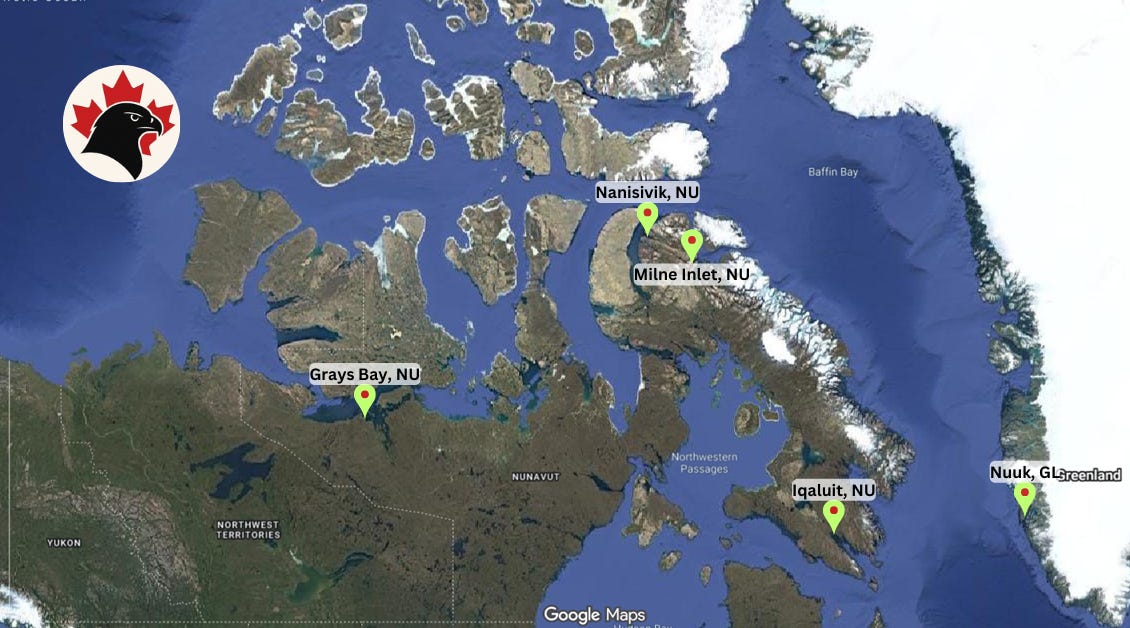
And yet when Defence Minister David McGuinty was asked about the idea, the government’s response was described as “non-committal.”
That hesitation has puzzled some observers.
But in reality, Ottawa has several very good reasons not to rush into this.
The first reason is simple: there actually isn’t an offer to be accepted.
Tom Paddon, the company’s non-executive chair, has merely indicated that Baffinland would be “open to a conversation” about a lease or pay-for-use arrangement that would allow the military to use the port. The company expects to rely on the site less in the coming years as it develops a new port on the southern side of Baffin Island, and is apparently looking for another revenue stream.
Governments are rarely going to be more than “non-committal” toward a vague concept with no details attached. Doing so helps manage public expectations if nothing ultimately materializes — and protects the government’s negotiating position if discussions do move forward.
There is also the reality that major projects in the North require buy-in from Inuit communities, which are often cautious about new developments. This caution is not arbitrary. Canada has a long history of northern projects that damaged fragile ecosystems Inuit communities rely on, while failing to deliver the economic benefits that had been promised. Even if military use of Milne Inlet ultimately proves benign, assuming that from the outset — and publicly committing to the idea before consultations take place — could poison the goodwill any project would require to move forward.
The government’s experience trying to establish another naval facility nearby also helps explain its caution.
Milne Inlet lies roughly 150 kilometres from Nanisivik, a former mine site selected by Stephen Harper’s government in 2007 to fulfill an election promise to establish a deepwater port to refuel and resupply Royal Canadian Navy ships operating in the Arctic.
The argument behind Nanisivik was that existing mining infrastructure would make it quick and inexpensive to establish a naval refuelling facility. The site was originally expected to be operational by 2012.
Instead, the project has been plagued by delays.
A full two decades later, Nanisivik has yet to refuel a single ship. Planned construction is reportedly complete, but the jetty — the only piece of infrastructure remaining from the old mine — has deteriorated during the years of delay to the point that it is no longer fit for purpose. The government is now assessing whether it is worthwhile, or even possible, to repair or replace it. At present, there is no projected date for the facility to become operational.
In some respects, Milne Inlet appears to offer a way out of the Nanisivik quagmire.
Two of the major challenges at Nanisivik stemmed from the age and condition of the infrastructure. The Nanisivik mine had opened in the 1970s and closed in 2002, leaving facilities that were already decades old and had sat abandoned for years before the government attempted to repurpose them.
Milne Inlet, by contrast, opened in 2015 and remains in active use. This makes it newer and, in theory, would allow for a direct transition without the complications that come with reviving long-abandoned infrastructure.
However, the government would also have to consider the political implications of abandoning Nanisivik in favour of Milne Inlet.
There is little practical sense in maintaining both facilities. But walking away from a twenty-year project would inevitably carry political costs — both among communities that expected economic benefits from Nanisivik and among a broader electorate that might see the decision as an admission of failure. Managing that transition would require careful planning.
The lessons of Nanisivik also make officials wary of rushing into another seemingly simple solution.
Nanisivik was, after all, mining infrastructure in the Arctic that was supposed to be quickly and cheaply converted into a naval facility. Milne Inlet is now being pitched in much the same way. Even if some of Nanisivik’s problems don’t apply here, anyone involved in that earlier project is likely to be extremely reluctant to support a similar concept. At minimum, they will insist on a far more rigorous due-diligence process before committing to anything — something that was lacking during Nanisivik’s early stages.
Indeed, one of Nanisivik’s earliest setbacks emerged because of a lack of due diligence. When Nanisivik was originally selected, the presence of a nearby airstrip was touted as a major advantage. Only later did the government discover that the Government of Nunavut was already planning to close it — a detail missed during the rushed initial assessment.
In that context, one small detail in the Globe article is particularly interesting. It notes that the mine complex served by Milne Inlet includes a 6,500-metre gravel runway. What the article does not mention is that this runway is located roughly 100 kilometres from the port itself. In other words, the runway advertised as serving the port doesn’t actually serve it. History, it seems, has a habit of rhyming.
Finally, there is a more fundamental problem: Milne Inlet is not actually in the right place for the Royal Canadian Navy’s needs. To be fair, neither is Nanisivik. That misalignment is one reason the project has struggled to attract sustained political attention and resources.
The location problem dates back to the origins of the project. The commitment to build an Arctic naval facility was made in tandem with a promise to construct ice-capable patrol ships for the Navy — the vessels that eventually became the Harry DeWolf-class. The purpose of the facility was to support the ships. However, Nanisivik was selected before the design of those ships was finalized.
In the process of designing the ship, it was decided that they should have enough fuel to sail from St. John’s, Newfoundland, to Prince Rupoert, British Columbia — Canada’s two most northern ice-free ports — without refuelling and so had an immense 12,000km range. With range like that, Nanisivik offers only marginal advantages over existing options in Iqaluit or Nuuk.
What the Navy actually needs is a refuelling location significantly farther west — somewhere like Grays Bay, which is where the Government confirmed it plans to build a new port last week. Milne Inlet, by contrast, sits slightly farther east than Nanisivik, and deep inside a long inlet. From an operational perspective, it’s less useful than Nanisivik’s already imperfect location.
None of this means Milne Inlet cannot — or should not — play some role in Canada’s Arctic posture.
If Baffinland continues maintaining the infrastructure and the government simply pays for occasional access or pre-positions supplies there, the arrangement could turn out to be relatively low-risk. Especially until Grays Bay opens. If managed well, the opportunity for Ottawa to step away from Nanisivik with a ready-made option giving similar capability might be welcome.
But none of that gives the government a strong reason to rush. In the Arctic, the projects that look easiest on paper are often the ones that deserve the longest second look.
Thank you for reading this piece! I’m genuinely grateful that you took the time.
Work like this takes time and energy, and are easier to justify if they reach a large audience. If you found value in this, please take the time to like, share, and comment. You can even subscribe, for free or as a paying supporter!
If you’d like to support my work without the commitment of a paid subscription, you can also send me a one-time tip via Stripe, and buy me a coffee (or a little bit more).
Please don’t feel any pressure, all my work will continue to be available for free. However, earning a few dollars does make it easier for me to write pieces more often.
Good article, PH. It is best to leave Nanisivik on the back burner. At least Grays Bay can serve two purposes. The AOPS can easily fuelup in Grays Bay, move east or west and cover the northern leg of the Northwest Passage.
An Arctic port is a heavy lift but we’ve done these things before.
Weird, I though the announcement had an overhead photo showing a runway next to a heliport and the main facilities with a few zones for camps 💁🏻